Visitors can check out the Forum FAQ by clicking this link. You have to register before you can post: click the REGISTER link above to proceed. To start viewing messages, select the forum that you want to visit from the selection below. View our Forum Privacy Policy.
Want to receive the latest contracting news and advice straight to your inbox? Sign up to the ContractorUK newsletter here. Every sign up will also be entered into a draw to WIN £100 Amazon vouchers!
You are not logged in or you do not have permission to access this page. This could be due to one of several reasons:
You are not logged in. If you are already registered, fill in the form below to log in, or follow the "Sign Up" link to register a new account.
You may not have sufficient privileges to access this page. Are you trying to edit someone else's post, access administrative features or some other privileged system?
If you are trying to post, the administrator may have disabled your account, or it may be awaiting activation.
Logging in...
Previously on "Monday Links from the Barnyard vol. CCXV"
Random tie knots - "In 2000, Cambridge physicists Fink and Mao figured out a way to list all possible tie knots. They did it by creating a formal language to describe tie knots... During 2013, I have worked out, in collaboration with Anders Sandberg, Meredith L. Patterson and Dan Hirsh, the ramifications of removing Fink and Mao's restrictions. We have condensed the formal language proposed by Fink and Mao to a language with (almost) no axioms and three symbols: W, T, U. T is a clockwise (turnwise) move of the knot-tying blade, W is a counter-clockwise move, and U tucks the blade under a previous bow. Whether to start with an inwards or outwards crossing can be deduced by counting the total number of W and T in the knot description string, and all possible strings in W and T produce possible tie knots." So naturally they've created an online tool to give you diagrams showing how to tie a randomly-selected knot from the set of all tie knots. ...
Seems like enumerating tie knots is quite a trendy academic cottage industry
The following paper was posted to the ArXiv only last week
Some consultants in suits saying that the lightbulb isn’t enterprise ready and needs to be made more modular and hook up to their Enterprise Service Bridge and Messaging Architecture and to communicate using 17 different SOAP and WS-* standards dreamed up by people with important job titles at BEA, Microsoft, Oracle and IBM, but which nobody has actually ever sat down and implemented without wanting to stab someone in the face so many times they don’t have a face left. Usually themselves.
Quite a nice day earlier, but now it's lunchtime the clouds gather to drive one back indoors to the Web:
How many software developers would it take to change a lightbulb? - Excellent rehash of the old joke by Tom Morris: "One person to go to the shop to buy a lightbulb. Another person who goes and tries to buy a lightbulb but fails because the shop doesn’t accept Bitcoin. He pops on to Reddit to complain and in the process compares his situation to that of the Jews in Nazi Germany." And so on
14 Days of Genitals - "It's been an entire year since Amy and Meaghan peer-pressured themselves into writing about the grossest animal sex facts they could find, spewing out one each day until their google search history threatened to become a sentient, malevolent beast. To save the world, and their eyeballs, they gave up on day 8. This year, there's no backing down... Prep yourself for two weeks of bizarre, fascinating, and typically pretty horrifying animal sex facts. We've got nothing but the best/worst for you, building to a natural crescendo on February 14th." The perfect Valentine's day read.
Amanda, @TrappedAtMyDesk on Twitter, Dies, Age Unknown - "She is survived by her 5,141 followers, but did she ever exist?" Jennifer Mendelsohn attempts to track down the young Canadian woman who supposedly died last year of advanced glioblastoma multiforme (mentioned in a post I linked to a few weeks back) and finds that the only evidence for her existence seems to be her Twitter account.
Random tie knots - "In 2000, Cambridge physicists Fink and Mao figured out a way to list all possible tie knots. They did it by creating a formal language to describe tie knots... During 2013, I have worked out, in collaboration with Anders Sandberg, Meredith L. Patterson and Dan Hirsh, the ramifications of removing Fink and Mao's restrictions. We have condensed the formal language proposed by Fink and Mao to a language with (almost) no axioms and three symbols: W, T, U. T is a clockwise (turnwise) move of the knot-tying blade, W is a counter-clockwise move, and U tucks the blade under a previous bow. Whether to start with an inwards or outwards crossing can be deduced by counting the total number of W and T in the knot description string, and all possible strings in W and T produce possible tie knots." So naturally they've created an online tool to give you diagrams showing how to tie a randomly-selected knot from the set of all tie knots.
Anatomy of a poisoned image: colour-coded JavaScript! - "You may have read recently about a newly-discovered attack that involves injecting code into your browser using poisoned image files." Very nifty little trick, though possibly less nifty when it turns your computer into a bot
Frank Sinatra Has a Cold - ""Frank Sinatra Has a Cold" ran in April 1966 and became one of the most celebrated magazine stories ever published, a pioneering example of what came to be called New Journalism -- a work of rigorously faithful fact enlivened with the kind of vivid storytelling that had previously been reserved for fiction." Gay Talese's classic profile of the crooner.
Every Apple reference ever made in Futurama and The Simpsons - "With a combined 33 seasons between them, both Futurama and The Simpsons are awash with references to Apple. Some of these references take the form of biting commentary while others are much more subtle."
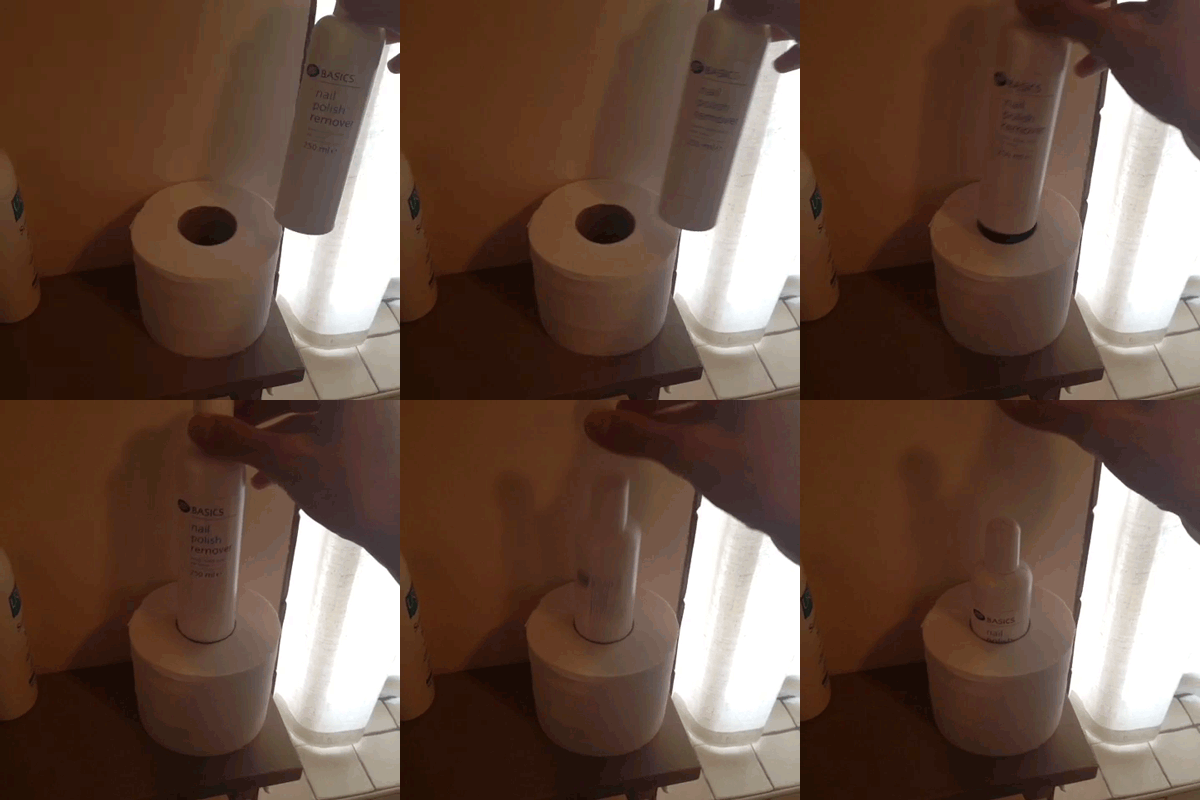
things fitting perfectly into other things - "Seeing totally unrelated objects perfectly nestle inside of each other provides a certain kind of peace in an otherwise chaotic world." Indeed:










Leave a comment: