

Oh No - more graphs!
C'mon, Blaster you can do better than that...
US NSIDC
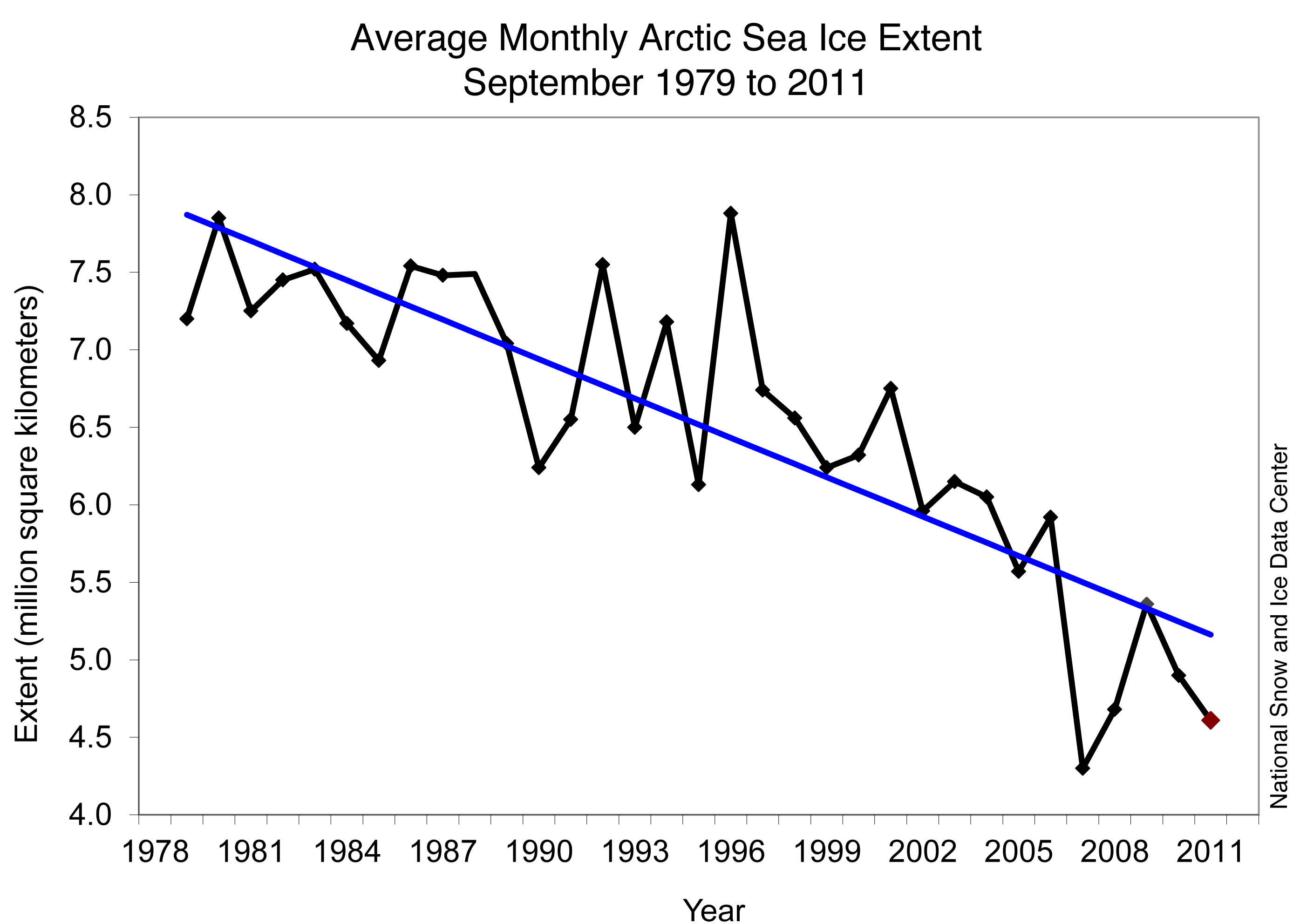
The Arctic ocean is largely enclosed and basically freezes over each winter - so the maximum ice extent in winter shows much less variation than the minimum in September. But it is the minimum that is significant for climatic reasons, as open sea absorbs about 90% of incoming radiation, while sea ice reflects about 90%. So how is the September trend looking?
You guys really are deep in denial aren't you?
C'mon, Blaster you can do better than that...
Arctic sea ice extent in January 2012 averaged 13.73 million square kilometers (5.30 million square miles). This is the fourth-lowest January ice extent in the 1979 to 2012 satellite data record, 1.10 million square kilometers (425,000 square miles) below the 1979 to 2000 average extent.
As in December, ice extent was lower than normal on the Atlantic side of the Arctic, especially in the Barents Sea. However, on the other side of the Arctic, ice extent in the Bering Sea was much greater than average, reaching the second-highest levels for January in the satellite record. The greater-than-normal ice extent in the Bering Sea partly compensated for low ice extent on the Atlantic side of the Arctic Ocean, but ice extent as a whole remained far below average.
As in December, ice extent was lower than normal on the Atlantic side of the Arctic, especially in the Barents Sea. However, on the other side of the Arctic, ice extent in the Bering Sea was much greater than average, reaching the second-highest levels for January in the satellite record. The greater-than-normal ice extent in the Bering Sea partly compensated for low ice extent on the Atlantic side of the Arctic Ocean, but ice extent as a whole remained far below average.
The Arctic ocean is largely enclosed and basically freezes over each winter - so the maximum ice extent in winter shows much less variation than the minimum in September. But it is the minimum that is significant for climatic reasons, as open sea absorbs about 90% of incoming radiation, while sea ice reflects about 90%. So how is the September trend looking?
You guys really are deep in denial aren't you?





Comment