Originally posted by AtW
View Post
- Visitors can check out the Forum FAQ by clicking this link. You have to register before you can post: click the REGISTER link above to proceed. To start viewing messages, select the forum that you want to visit from the selection below. View our Forum Privacy Policy.
- Want to receive the latest contracting news and advice straight to your inbox? Sign up to the ContractorUK newsletter here. Every sign up will also be entered into a draw to WIN £100 Amazon vouchers!
Reply to: Physics question - static equilibrium
Collapse
You are not logged in or you do not have permission to access this page. This could be due to one of several reasons:
- You are not logged in. If you are already registered, fill in the form below to log in, or follow the "Sign Up" link to register a new account.
- You may not have sufficient privileges to access this page. Are you trying to edit someone else's post, access administrative features or some other privileged system?
- If you are trying to post, the administrator may have disabled your account, or it may be awaiting activation.
Logging in...
Previously on "Physics question - static equilibrium"
Collapse
-
Christ you lot are THICK.
THICK.
If you CRETINS hadn't wasted your time at school and got a proper education you would have this solved in seconds!
Leave a comment:
-
Then you'd need the sine of d and e.Originally posted by alluvial View PostAh, but try hanging two masses on the string....
Leave a comment:
-
Yay, so we're all right!Originally posted by alluvial View PostThis could be where the problem is.
Leave a comment:
-
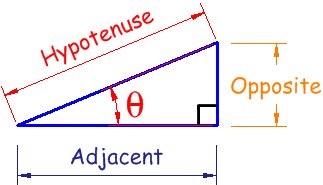
Sorry, but suity's post wasn't complete nonsense.Originally posted by mudskipper View PostYes dear, but the opposite/adjacent thing isn't in relation to the hypotenuse, it's in relation to the angle you know - so your post was nonsense.
Here's a picture for you.

His first statement is correct and agrees with my previous post.
As the system is in static equilibrium, then the sum of the forces must equate to zero. As this is a 2D system, then you only need to consider the xy plane and so the sum of the forces acting upwards at the point of susppension must equal the downwards force created by the mass and so:
F=19 cos(a) + 12 cos(b) This is the force that stops the mass from dropping downwards.
The adjacent side in this case is the perpendicular and so cosine is used.
His second statement was (almost) wrong as this will only be true if a=b.
You then resolve the forces perpendicular to the direction in which the mass exerts a force. In this case, sine will be used and now, 19sin(a) = 12sin(b). This needs to be true to stop the mass from moving sideways.
Once you can determine what a or b are, then you can solve the first equation and then determine M by dividing by g.
Edit: BTW, I'm using a and b to be the angles obtained by subdividing the angle formed by the two suspension cables at the point of suspension.
Leave a comment:
-
Leave a comment:
-
Ooooooh, a picture, has it got kittens in it?Originally posted by mudskipper View PostYes dear, but the opposite/adjacent thing isn't in relation to the hypotenuse, it's in relation to the angle you know - so your post was nonsense.
Here's a picture for you.

No, oh, as you were then.
P.S. Suity, she called you Dear, but somehow I don't think you've pulled.
Leave a comment:
-
Yes dear, but the opposite/adjacent thing isn't in relation to the hypotenuse, it's in relation to the angle you know - so your post was nonsense.Originally posted by suityou01 View PostOooh spooky, there's an echo.
Here's a picture for you.
Leave a comment:
- Home
- News & Features
- First Timers
- IR35 / S660 / BN66
- Employee Benefit Trusts
- Agency Workers Regulations
- MSC Legislation
- Limited Companies
- Dividends
- Umbrella Company
- VAT / Flat Rate VAT
- Job News & Guides
- Money News & Guides
- Guide to Contracts
- Successful Contracting
- Contracting Overseas
- Contractor Calculators
- MVL
- Contractor Expenses
Advertisers
Contractor Services
CUK News
- HMRC standstill agreements extended to 72 months: why the term's doubled, and what to check before signing Jul 31 05:53
- Who owns the loans? Inside the mystery of the loan charge recall scandal Jul 30 06:20
- Umbrella company winding-up petitions in 2026: the practical guide for contractors Jul 29 05:29
- Payments on Account deadline: what contractors must do before July 31st — maybe for the final few times Jul 28 08:01
- Andy Burnham's first 100 days: five things contractors need from the new PM Jul 27 00:53
- Starmer vs Burnham on housing: What their rival plans mean for your contractor mortgage Jul 22 00:59
- Burnham's housing vision vs. Starmer's home-buying reforms: what it means for your contractor mortgage Jul 22 00:59
- In Khalil v Innovate Transport, a limited company contractor wasn’t a worker and was on £2.30 — not £230 Jul 21 07:58
- Andy Burnham is PM: 5 new IT policies set to shape UK tech and its contractors Jul 20 06:29
- Taxed on money I haven't earned yet? Bold move, HMRC Jul 17 08:36


Leave a comment: