Want to receive the latest contracting news and advice straight to your inbox? Sign up to the ContractorUK newsletter here. Every sign up will also be entered into a draw to WIN £100 Amazon vouchers!
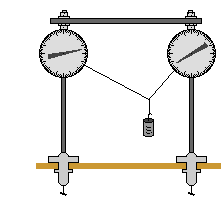
Consider the above. The force on the left hand cable is 12N, the force of the right hand cable is 19N. The system is in static equilibrium. What is the mass of the weight?
It's my daughter's homework. I seem to have forgotten how to do physics....
Consider the above. The force on the left hand cable is 12N, the force of the right hand cable is 19N. The system is in static equilibrium. What is the mass of the weight?
It's my daughter's homework. I seem to have forgotten how to do physics....
If it's in static equilibrium, then the sum of the components of forces in the x axis will be zero and likewise will be zero in the y-axis.
So you should also have -12sin(b) + 19sin(a) = 0 and
12cos(a) +19cos(a) - W = 0 (Where w is the weight of the mass)
As I said above, you have to consider that the system is in static equilibrium and for this, the sum of the forces and the sum of the torques have to sum to zero.
I don't think you worry about the torque in this case but you construct equations by resolving the various forces at the points in the systems where forces are acting. So here, at the point the weight is hanging on the string and at the two points where the cables connect to the scales.
Then resolve all the forces into the x and y axis and at the point where the weight hangs, you get:
-12sin(b) + 19sin(a) = 0 and
12cos(a) +19cos(b) - W = 0 (Where w is the weight of the mass)
You have to remember that these are vectors and so take the direction into account.
I think you also need to do this at the other two points in the system and you should have a whole mess of equations that can be solved. Me, I've had tooo many Stellars for me to go solving any trig equations so I'll leave it to you.
I think the first equation is wrong. Yes you have two right angled triangles, one with a hypotenuse of magnitude 12N, and one with 19N. To resolve the downward components of each, the downward force is using the angle adjacent to the hypotenuse. IIRC SOHCAHTOA, so
F=19 cos(a) + 12 cos(b)
Since the system is in equilibrium then
19 cos(a) = 12 cos(b)
(as you rightly pointed out).
Still absolutely no ******* clue how to solve 3 unknowns with 2 equations, just wanted to get your first equation right.