
Originally posted by inniAccounts
View Post
- Visitors can check out the Forum FAQ by clicking this link. You have to register before you can post: click the REGISTER link above to proceed. To start viewing messages, select the forum that you want to visit from the selection below. View our Forum Privacy Policy.
- Want to receive the latest contracting news and advice straight to your inbox? Sign up to the ContractorUK newsletter here. Every sign up will also be entered into a draw to WIN £100 Amazon vouchers!
Reply to: Max Div come new tax year
Collapse
You are not logged in or you do not have permission to access this page. This could be due to one of several reasons:
- You are not logged in. If you are already registered, fill in the form below to log in, or follow the "Sign Up" link to register a new account.
- You may not have sufficient privileges to access this page. Are you trying to edit someone else's post, access administrative features or some other privileged system?
- If you are trying to post, the administrator may have disabled your account, or it may be awaiting activation.
Logging in...
Previously on "Max Div come new tax year"
Collapse
-
Minor point: the tool does not support the scenario where income above the VAT registration threshold is outside of the scope of VAT.
-
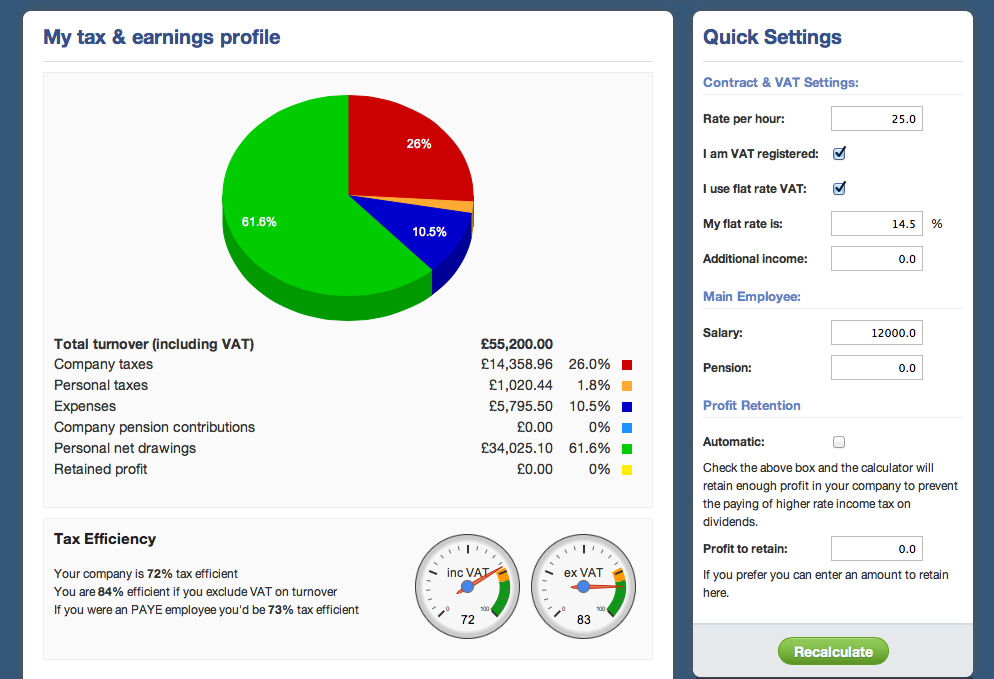
Pretty handy calculator that one!Originally posted by inniAccounts View PostIf you want to get into the details of dividend tax planning we've got a really comprehensive (I'll be bold enough to say the most comprehensive) limited company tax calculator here: Contractor Tax Calculator - The UK's Most Powerful Contractor Calculator. It's designed to allow you to play with different scenarios and see instantly what the tax impact will be.
It's just been updated with the 2013/14 rates plus if you're inclined you can do a side-by-side comparison with 2012/13.
In this case just hit the 'Start My Calculation' button, check your turnover and vat settings, then pop in a salary of £12k on the next page. You'll soon end up with a tax profile, which looks something like this:
Leave a comment:
-
If you want to get into the details of dividend tax planning we've got a really comprehensive (I'll be bold enough to say the most comprehensive) limited company tax calculator here: http://www.contractor-tax-calculator.co.uk. It's designed to allow you to play with different scenarios and see instantly what the tax impact will be.
It's just been updated with the 2013/14 rates plus if you're inclined you can do a side-by-side comparison with 2012/13.
In this case just hit the 'Start My Calculation' button, check your turnover and vat settings, then pop in a salary of £12k on the next page. You'll soon end up with a tax profile, which looks something like this:
Leave a comment:
-
There's nothing concrete to say that a smaller salary will increase your chances of investigation, and it's perfectly legal to structure your affairs in the way that best minimises tax. Our view is that £12,000 can be seen as more commercial, but it's entirely up to you to make the final decision.
You may get a totally random investigation at some point anyway, so as long as your accounts are in order and you're happy with your IR35 status then you have nothing to worry about. Many initial enquiries from HMRC can be stopped in their tracks quickly as long as you can answer their questions promptly and adequately.
Leave a comment:
-
Thanks Claire.
Is there any additional risk (in terms of investigations / undue attention from HMRC) if a company pays salary and dividends such that there is no Tax / NI liability?
My accountant has just sent a note that they recommend £10000 / annum as salary (even though they recomended £7488 for the current year) and they have also included a clause in the note saying that "they cannot be held responsible for the salary structure in case of an investigation, if the clients choose £7696 as their salary".
Leave a comment:
-
I can agree your workingsOriginally posted by Master View PostMost efficient salary that includes NI stamp towards pension but no PAYE / NI is
£7696 / year, which I rounded down to £7692 / year or £641 / month, as I prefer whole numbers.
This leaves Gross dividend of £33758 (inclusive of Dividend tax credits) and a net dividend of £30382.20 for the year.
This is of course, assuming that there is no other income apart from the salary and dividend. (Interest / Rent / Dividends from other investments etc).
Accountants can you please validate the numbers?
Leave a comment:
-
I'm not an accountant but it looks right to me. Using £7,696 as my salary I worked out that that leaves me £33,754 gross divis, or £30,378.60 net, which tallies with your figures.Originally posted by Master View PostMost efficient salary that includes NI stamp towards pension but no PAYE / NI is
£7696 / year, which I rounded down to £7692 / year or £641 / month, as I prefer whole numbers.
This leaves Gross dividend of £33758 (inclusive of Dividend tax credits) and a net dividend of £30382.20 for the year.
This is of course, assuming that there is no other income apart from the salary and dividend. (Interest / Rent / Dividends from other investments etc).
Accountants can you please validate the numbers?
It gives me a total of £38,074 this year as opposed to £38,976 last year
Leave a comment:
-
Most efficient salary that includes NI stamp towards pension but no PAYE / NI is
£7696 / year, which I rounded down to £7692 / year or £641 / month, as I prefer whole numbers.
This leaves Gross dividend of £33758 (inclusive of Dividend tax credits) and a net dividend of £30382.20 for the year.
This is of course, assuming that there is no other income apart from the salary and dividend. (Interest / Rent / Dividends from other investments etc).
Accountants can you please validate the numbers?
Leave a comment:
-
Salary of £7,696, then divi for the rest, haven't worked out the exact figure yet.Originally posted by Ketchup View Post2012/2013 i was paying myself £675 a month and then took myself up to the higher threshold with a dividend.
For 2013, what is the most tax efficient way of paying yourself up to the higher tax threshold?
Edit: That's only £641.33 a month, you were paying too much last year.
Leave a comment:
-
2012/2013 i was paying myself £675 a month and then took myself up to the higher threshold with a dividend.
For 2013, what is the most tax efficient way of paying yourself up to the higher tax threshold?
Leave a comment:
-
Oh yeah, ta.
Not sure how I got to my figure, must be some old allowance figures.
Leave a comment:
-
Max Div come new tax year
Annual salary 12k
Max div no extra taxes, on 6th April = £27428.40?Tags: None
- Home
- News & Features
- First Timers
- IR35 / S660 / BN66
- Employee Benefit Trusts
- Agency Workers Regulations
- MSC Legislation
- Limited Companies
- Dividends
- Umbrella Company
- VAT / Flat Rate VAT
- Job News & Guides
- Money News & Guides
- Guide to Contracts
- Successful Contracting
- Contracting Overseas
- Contractor Calculators
- MVL
- Contractor Expenses
Advertisers


Leave a comment:


